




8 June 2026

In concrete block and paving stone production, efficiency cannot be measured only by the capacity of the main machine. Mortar preparation, pressing, product handling, palletizing, packaging, and shipment preparation must all work in harmony. This is why robotic handling systems have become an important part of modern concrete product manufacturing plants.
In high-capacity production facilities, products must be moved to the right point at the right time and with maximum control. Manual handling methods may cause time loss, product damage, safety risks, and operational inconsistency, especially under intensive production conditions. Robotic handling solutions make this process safer, faster, and more standardized, helping the entire production line operate more efficiently.
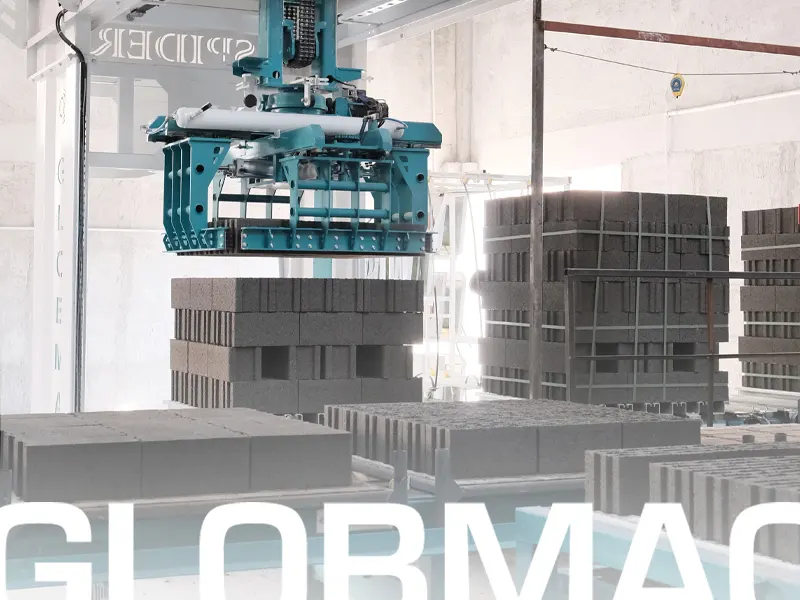
The collection and packaging systems developed by GLOBMAC A.Ş. are designed to manage post-production processes more effectively in concrete block, paving stone, and curbstone production lines. Equipment such as Spider-X, pallet transfer robots, strapping robots, stretch wrapping robots, block turning robots, block forklift tine opening systems, and washing robots are among the key systems that support product flow in the final stages of production.
Concrete products must be managed correctly even after they leave the production machine. In products such as paving stones, concrete blocks, and curbstones, surface quality, stacking order, pallet balance, and shipment preparation directly affect the final quality perception. Incorrect handling or disorganized stacking may lead to breakage, surface damage, alignment problems, and product waste.
At this point, robotic handling systems help post-production processes move forward in a more controlled way. Picking, moving, turning, palletizing, or packaging products in a defined order improves the overall efficiency of the production line. It also reduces operator intervention and supports a safer working environment.
Especially in fully automatic or high-capacity production lines, robotic handling solutions adapt to the speed of the main machine and help the line continue without unnecessary interruptions. In this way, machine performance is supported not only during production, but also throughout the collection and packaging stages.
GLOBMAC A.Ş. collection and packaging systems are supported by different robotic equipment developed to make the process from product exit to shipment more efficient. These systems do more than move products; they also contribute to a more organized, safe, and sustainable production flow.
Spider-X is one of the robotic systems used in the collection and handling stages after products leave the production line. It plays an important role in picking products in the correct order, guiding them in a balanced way, and moving them in line with the production flow. This structure helps the robotic handling process become more precise and organized.
With systems such as Spider-X, post-production product management becomes more planned. This contributes to protecting product surfaces, maintaining alignment order, and reducing unnecessary waiting times in paving stone and concrete block production.
Pallet transfer robots allow pallet movements to be managed in a more controlled way within the production line. In concrete product manufacturing, transferring pallets to the right point at the right time is a critical detail for line continuity. Any disruption in pallet flow can directly affect the production rhythm.
For this reason, pallet transfer solutions have an important place in robotic handling systems. Regular pallet movement supports the product output process and keeps the line aligned with the overall operational plan. As a result, production becomes not only faster, but also more balanced and easier to manage.
Concrete products leaving the production line must not only be moved; they must also be prepared safely for shipment. Strapping robots and stretch wrapping robots help make the packaging process more standardized and reliable at this stage.
These systems help products remain more stable on the pallet and better protected during transportation. Maintaining packaging standards before shipment reduces the risk of product damage during storage and logistics operations.
Block turning robots are practical solutions used to bring products into the correct position for packaging or shipment. When products need to be redirected, turned, or positioned, robotic systems reduce the need for manual intervention.
Auxiliary systems such as block forklift tine opening systems and washing robots also make post-production processes more functional. When all these systems are considered together, robotic handling is not simply about moving a product from one point to another. It is a complete approach to managing the final stages of the production line.
Robotic handling systems offer significant technical and operational advantages in production lines. These benefits become especially visible in facilities with high-volume daily production.
These advantages make robotic handling systems much more than equipment that simply increases speed. When planned correctly, a robotic structure supports a more balanced, predictable, and sustainable operation across the entire production line.
In concrete block and paving stone production, quality is not determined only during the pressing and vibration stages. How a product is picked, moved, stacked, and prepared for shipment after leaving the machine is also part of the quality process.
Robotic handling systems help reduce unnecessary contact with products. With more controlled handling and palletizing, the risk of edge breakage, surface damage, or stacking misalignment decreases. This provides a major advantage, especially in paving stone production where visual appearance is an important quality factor.
Supporting the packaging process with robotic systems also improves product safety before shipment. Standardized strapping and stretch wrapping help products remain more stable during storage and transportation.
Concrete products are heavy, bulky, and must be handled in an organized way. For this reason, when manual labor is heavily involved in post-production processes, both time loss and safety risks may increase. Robotic handling systems reduce the physical workload of operators and help create a safer working environment.
This structure allows personnel to focus on system control, quality monitoring, and process management instead of repetitive heavy tasks. As a result, labor is used more efficiently while the level of operational control in the production line increases.
GLOBMAC A.Ş. develops not only main machine solutions for concrete block, paving stone, curbstone, and similar concrete product manufacturing, but also integrated systems that complete different stages of the line. Collection and packaging systems are an important part of this approach.
Spider-X, pallet transfer robots, strapping robots, stretch wrapping robots, block turning robots, and other auxiliary systems provide continuity, order, and safety in the final stages of production. For this reason, robotic handling is a strategic investment in modern concrete product manufacturing plants, helping increase efficiency and support production quality.
Robotic handling systems can be used in production lines for concrete blocks, paving stones, curbstones, briquettes, grass stones, and similar concrete products. They can take part in post-production collection, handling, palletizing, turning, and packaging processes.
Spider-X is a robotic system that helps collect and handle products more systematically after they leave the production line. It contributes to a more controlled product flow and more efficient management of post-production processes.
Strapping and stretch wrapping robots help prepare products more safely for shipment. These systems support product stability on the pallet and help protect products during transportation.
Yes. Robotic handling systems reduce waiting times by moving products faster and more regularly. This helps manufacturers use the existing capacity of the production line more efficiently.
Applicability depends on the facility layout, production capacity, product type, and existing line structure. For the best results, the system should be planned according to the specific production line.
Discover robotic handling and packaging solutions tailored to your production line with GLOBMAC A.Ş.